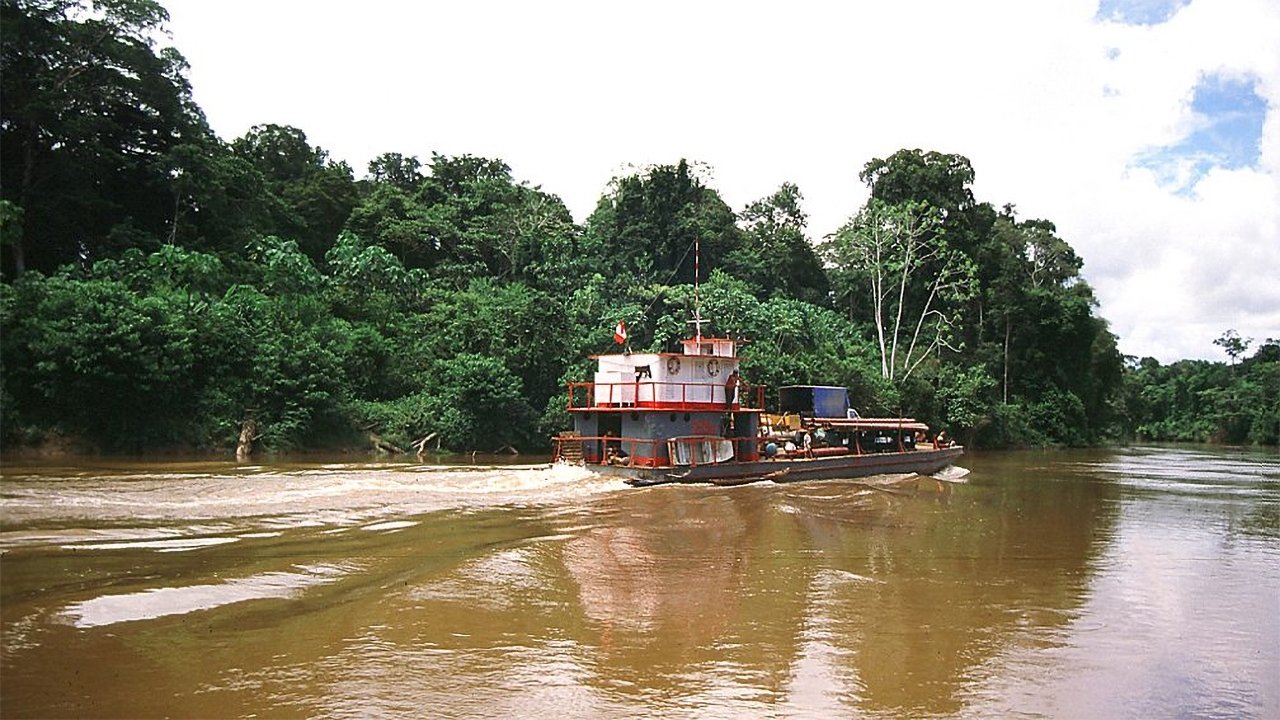


Series following the high adrenaline adventures of a team of divers as they explore and film the depths of the world's greatest river system.
Social & External
Self - Presenter
Self - Narrator
Angler and biologist Jeremy Wade uncovers the bizarre, the weird and the mysterious as he investigates baffling, unsolved mysteries beneath the surface of dark waters.
For several thousand years the moose have walked the same path to get to the rich pastures of summer. Follow the walk live from Kullberg in the north of Sweden.
The islands of New Zealand are home to an entirely unique menagerie of creatures. It is a place where the normal rules don't apply - the birds can't fly, a small, ancient lizard is a top predator, parrots play in snowy mountain meadows and penguins roam the streets. Seals battle on the beaches, albatrosses soar on the air currents and a monster movie plays out in miniature among the dense undergrowth of this lush, vital land.
Australia's biodiversity thrives in the diverse terrestrial and marine habitats that span the country. Lush rainforests offer a refuge for countless plants and animals, while the vast dry eucalyptus woodland is home to numerous specially adapted species. Kangaroos, wallabies and platypuses are just a few of the iconic animals that call Australia home, showcasing the country's evolutionary distinctiveness. Meanwhile, the waters surrounding the country support some of the most spectacular marine biodiversity on the planet. Vibrant coral reefs, seagrass meadows and rocky shorelines contribute to the country's rich marine tapestry. This is a unique world filled with stunning natural beauty, inhabited by some of the most extraordinary and deadly animals on the planet.
Follows powerful matriarchs of the animal kingdom, spotlighting the universality of motherhood and exploring what mothers of any species will do to protect their young.
Discover the remarkable ways animals of all shapes and sizes are adapting to make the most of opportunities in the newest and fastest changing habitat on the planet - our cities.
Traveling to the far corners of the world, we discover the extraordinary ways animals are adapting to our rapidly changing planet. We witness nature’s remarkable resilience, as our perception of evolution and its potential is forever transformed.
A journey into the heart of Costa Rica's unique landscape following the efforts undertaken by scientists and citizens to preserve and restore the country's valuable natural heritage.
Chilling tales of survival unfurl in this documentary series that captures the drama, danger and dark beauty of nature from the perspective of its prey.
A celebration of California’s wildlife and wild places, and their coexistence with the 40 million people who call it home. Famous for its beaches and Hollywood, California is also a wellspring of biodiversity. Bounded by mountains, deserts and the Pacific Ocean, here are iconic wild places like Yosemite National Park and Death Valley, as well as Baja California’s lesser-known wild beauty.
Namibia is a country of contrasts, from the arid savannahs to flowing rivers and rugged coastlines. This documentary explores the natural wonders of the country in southern Africa. Despite the dry and barren habitat, the Kalahari Desert in the east is home to a range of rare and fascinating creatures. Animals must be resourceful and clever to survive in the world’s oldest desert and one of the driest places on Earth, the Namib.
Venture across world-famous and lesser-known national parks to reveal the diversity and wonder of the United States, from the lush valley floors of Yosemite to the constantly erupting volcanoes of Hawai'i.
David Attenborough uses pioneering 3D-techniques and technology to explore the unique environments and species of the Galapagos.
Baboons with Bill Bailey is a wildlife documentary series presented by Bill Bailey. The series follows Bill as he attempts to find out more about the lives of baboons who are living in several colonies in Cape Town, South Africa.
Three wildlife camera operators follow six iconic baby animals as they face the challenges of surviving their first year on Earth.
Geologist Iain Stewart explain in three stages of natural history the crucial interaction of our very planet's physiology and its unique wildlife. Biological evolution is largely driven bu adaptation to conditions such as climate, soil and irrigation, but biotopes were also shaped by wildlife changing earth's surface and climate significantly, even disregarding human activity.
Dive into the extraordinary worlds of six tiny animals as they embark on the biggest journeys of their lives.
A three-part British documentary film series about life in the Paleozoic, bringing to life extinct arthropods, fish, amphibians, synapsids, and reptiles. Narrated by Kenneth Branagh and using state-of-the-art visual effects, this prequel to Walking with Dinosaurs shows nearly 300 million years of Paleozoic history, from the Cambrian Period (530 million years ago) to the Early Triassic Period (248 million years ago).
There is nowhere more powerful and unforgiving yet more beautiful and compelling than the ocean. Join us and explore the greatest yet least known parts of our planet.
Will Smith whose curiosity and wonder is positively infectious—is guided by National Geographic Explorers traveling to different corners of the world to get up close and personal with the weirdest, most unusual, dangerous and thrilling spectacles of the planet.
Maritime mysteries—old and new—come to life in this series, combining scientific data and digital re-creations to reveal shipwrecks, treasures, and sunken cities on the bottom of lakes, seas and oceans around the world.
Investigates a wide range of historically compelling topics and the mysteries surrounding each including the Titanic, D.B. Cooper, Roswell, John Wilkes Booth, and more. Fresh, new evidence and perspectives will be showcased, such as never-before-released documents, personal diaries and DNA evidence.
Natural World is a nature documentary television series broadcast annually on BBC Two and regarded by the BBC as its flagship natural history brand. It is currently the longest-running series in its genre on British television, with more than 400 episodes broadcast since its inception in 1983. Natural World is produced by the BBC Natural History Unit in Bristol, but individual programmes can be in-house productions, collaborative productions with other broadcasters or films made and distributed by independent production companies and purchased by the BBC. Natural World programmes are often broadcast as PBS Nature episodes in the USA. Since 2008, most Natural World programmes have been shot and broadcast in high definition.
Filmed across six continents, this docuseries uses cutting-edge camera technology to capture animals' nocturnal lives, revealing new behaviours filmed in full color like never before.
Australian host Steve Irwin and his wife Terri run a wildlife refuge. Their shared passion is educating the world about wildlife, including the much feared crocodile and numerous venomous snakes. Steve's specialty is the capture and relocation of crocodiles. No animal appears too threatening to Steve, his true respect for animals is the foundation for everything he does.
Sir David Attenborough narrates this critically acclaimed series that dives deep into the marine environment of Planet Earth. Although two-thirds of the world's surface is covered with water, scientists know less about the oceans than they do about the surface of the moon. This limited series travels from various coasts to the poles to examine watery denizens ranging from the gigantic blue whale to microscopic coral polyps.
David Attenborough presents a documentary series exploring how animals meet the challenges of surviving in the most iconic habitats on earth.
PBS' premier science series helps viewers of all ages explore the science behind the headlines. Along the way, NOVA demystifies science and technology, and highlights the people involved in scientific pursuits.
Experience the wonders of our world like never before in this epic series from Jon Favreau and the producers of Planet Earth. Travel back 66 million years to when majestic dinosaurs and extraordinary creatures roamed the lands, seas, and skies.
Inspired by his late mentor, Will Smith spends 100 days facing extreme challenges, venturing from pole to pole with scientists, explorers and experts.
David Attenborough celebrates the amazing variety of the natural world in this epic documentary series, filmed over four years across 64 different countries.
Documentary series tracking the dreams and worries of Wrexham, a working-class town in North Wales, UK, as two Hollywood stars (Rob McElhenney and Ryan Reynolds) take ownership of the town’s historic yet struggling football club.
This immersive series follows the world's most magnificent creatures, capturing never-before-seen moments from the heartwarming to the outrageous.
Discover the stories beneath the surface of the water in this stunning nature documentary series, which explores each of the Earth's five oceans.
In Search of... is a TV series that was broadcast weekly from 1977 to 1982, devoted to mysterious phenomena. It was created after the success of three one-hour TV documentaries produced by creator Alan Landsburg: In Search of Ancient Astronauts in 1973, In Search of Ancient Mysteries and The Outer Space Connection, both in 1975. All three featured narration by Rod Serling, who was the initial choice to host the spin-off show. After Serling's death, Leonard Nimoy was selected to be the host.

Witness the remarkable story of our universe over billions of years and its inextricable link to life on Earth in this sweeping documentary series.
Consistently stunning documentaries transport viewers to far-flung locations ranging from the torrid African plains to the chilly splendours of icy Antarctica. The show's primary focus is on animals and ecosystems around the world. A comic book based on the show, meant to be used an as educational tool for kids, was briefly distributed to museums and schools at no cost in the mid-2000s.

Infographics and archival footage deliver bite-size history lessons on scientific breakthroughs, social movements and world-changing discoveries.